


The Dot Product (also known as the Scalar Product) of two vectors is a crucial and consistently tested concept in your Karnataka Diploma Mathematics examination. Understanding how to calculate it and, more importantly, how to use it to find the angle between two vectors or check for orthogonality is key to scoring valuable marks. For clear, exam-focused guidance, the Ravi R Nandi YouTube Channel is an invaluable resource.
📘 The Formula: Calculating the Dot Product
There are two primary ways to calculate the dot product, depending on the information given. Both are essential for your exams.
1. Using Components ($\hat{i}, \hat{j}, \hat{k}$)
If you have two vectors, $\vec{A}$ and $\vec{B}$, defined by their components:
- $\vec{A} = a_1\hat{i} + a_2\hat{j} + a_3\hat{k}$
- $\vec{B} = b_1\hat{i} + b_2\hat{j} + b_3\hat{k}$
The Dot Product $\vec{A} \cdot \vec{B}$ is found by multiplying the corresponding components and summing them up:
$$\vec{A} \cdot \vec{B} = a_1b_1 + a_2b_2 + a_3b_3$$
Example: If $\vec{A} = 2\hat{i} + 3\hat{j} – \hat{k}$ and $\vec{B} = \hat{i} – 2\hat{j} + 4\hat{k}$, find $\vec{A} \cdot \vec{B}$.
Solution:$\vec{A} \cdot \vec{B} = (2)(1) + (3)(-2) + (-1)(4)$$\vec{A} \cdot \vec{B} = 2 – 6 – 4$$\vec{A} \cdot \vec{B} = -8$
2. Using Magnitudes and the Angle Between Vectors
If you know the magnitudes of the two vectors and the angle $\theta$ between them:
$$\vec{A} \cdot \vec{B} = |\vec{A}||\vec{B}|\cos\theta$$
This formula is critical for finding the angle between two vectors, which is a very common exam question.
🎯 Key Applications of the Dot Product in Exams
The dot product is not just a calculation; it’s a tool! Here are its most frequent applications in your Diploma exams:
1. Finding the Angle Between Two Vectors ($\cos\theta$)
This is a high-probability question. The formula derived from the dot product is:
$$\cos\theta = \frac{\vec{A} \cdot \vec{B}}{|\vec{A}||\vec{B}|}$$
To solve this:
- Calculate $\vec{A} \cdot \vec{B}$ using the component method.
- Calculate the magnitudes $|\vec{A}|$ and $|\vec{B}|$ using the formula $\sqrt{x^2 + y^2 + z^2}$.
- Substitute these values into the $\cos\theta$ formula.
- Find $\theta = \cos^{-1}\left(\frac{\vec{A} \cdot \vec{B}}{|\vec{A}||\vec{B}|}\right)$.
2. Checking for Orthogonality (Perpendicular Vectors)
Two vectors are orthogonal (or perpendicular) if the angle between them is $90^\circ$. Since $\cos(90^\circ) = 0$, this leads to a simple and vital condition:
If $\vec{A} \cdot \vec{B} = 0$, then $\vec{A}$ and $\vec{B}$ are orthogonal.
This is a common “prove that” or “show that” type of question in your exam.
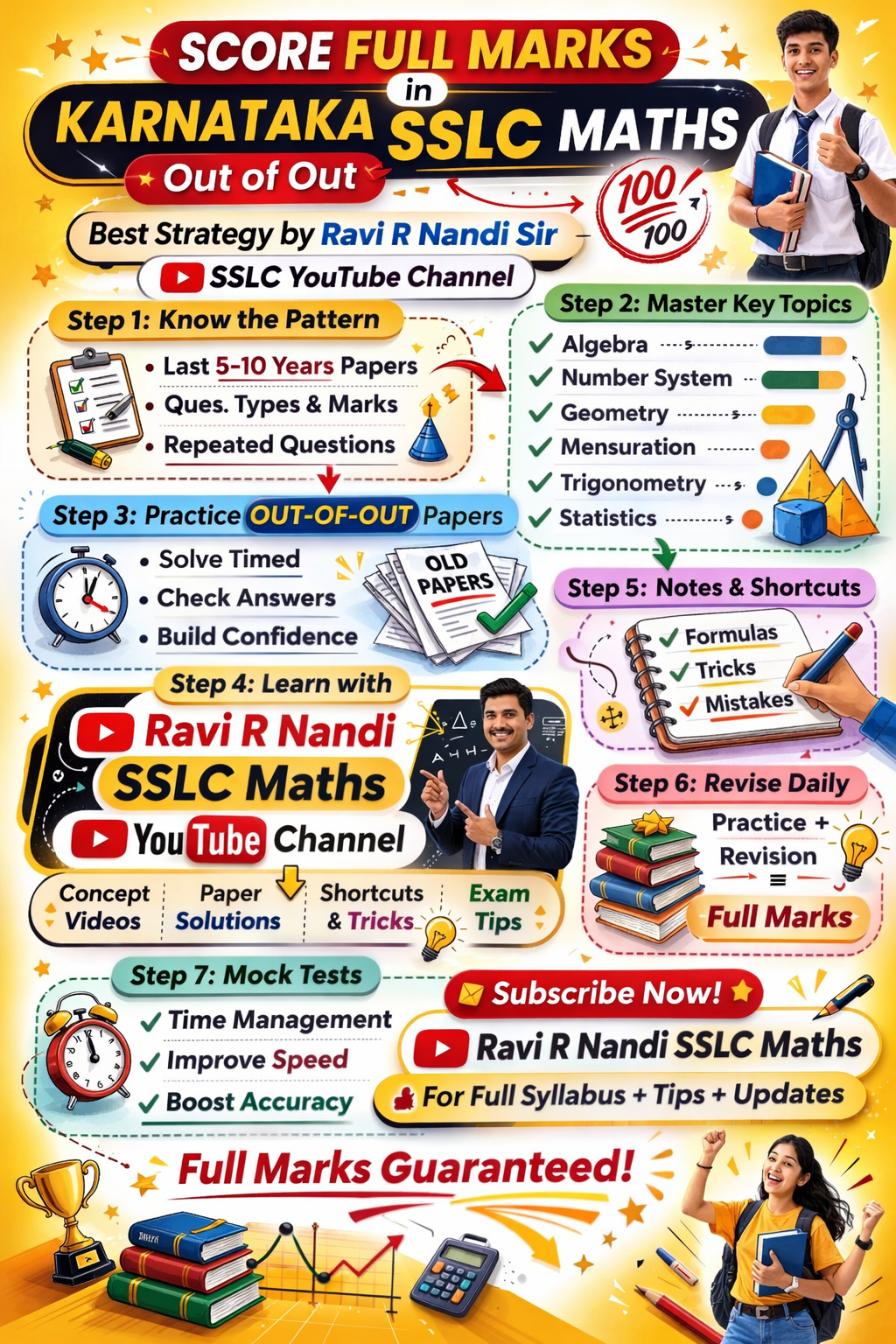
📺 Learning with Ravi R Nandi
The Ravi R Nandi YouTube channel is tailored for Karnataka Diploma students, providing clear, concise, and exam-focused explanations.
- Dedicated Videos: Look for videos like “01 | Sum & Dot Product of Two Vectors | Easy for Karnataka Diploma Students | Ravi R Nandi” and “02 | Orthogonal of Two Vectors | Easy for Karnataka Diploma Students | Ravi R Nandi.” These directly address the calculation and application of the dot product, including finding angles and checking for orthogonality.
- Problem Solving: Ravi R Nandi Sir walks through typical exam problems step-by-step, showing you exactly how to present your solution to secure full marks.
- “Passing Package” Content: The dot product is invariably part of his “Passing Package” sections, highlighting its importance and ensuring you know the essential questions.
✅ Final Thoughts for Exam Success
Mastering the dot product is a guaranteed way to score well in the vectors chapter. Pay close attention to:
- The correct calculation of the dot product using components.
- The magnitude formula for vectors.
- The application of these in finding angles and testing for orthogonality.
🔔 Don’t Miss Out: Subscribe to Ravi R Nandi for Better Results!
To ensure you’re fully prepared for your Karnataka Diploma Mathematics exams, the Ravi R Nandi YouTube channel is your ideal study companion. With comprehensive “Passing Packages,” model paper solutions, and simplified explanations, he makes complex topics easy to understand.
Subscribe now and enable notifications to receive all the latest exam-oriented content, tips, and tricks that will help you excel!








Leave a Reply